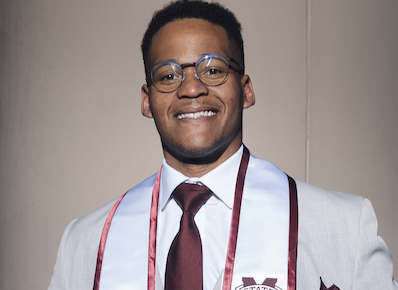
Omri Parks
He/Him
I am bisexual and I am a chemist.//
As a queer chemist, I know how meaningful it is to see people like yourself thriving in science. Throughout my career, I've been driven by curiosity and a desire to develop new materials that can address real-world health challenges, from antibiotic-resistant infections to targeted drug delivery. My research sits at the intersection of chemistry, nanotechnology, and immunology, where I study how engineered nanomaterials interact with the immune system and how those interactions can be harnessed to improve therapeutics.
I didn't realize I belonged in science because every experiment worked—I realized it after one finally did.
In the summer of 2021, I spent months collaborating on BaZrS3 chalcogenide perovskite nanomaterials, troubleshooting experiments, adjusting conditions, and questioning whether I was making any progress. When I finally achieved the result we had been working toward, everything clicked. It wasn't just the excitement of a successful experiment; it was the realization that I had persevered through failure and uncertainty to solve a difficult problem. That moment gave me the confidence to see myself as a scientist, giving the fact that I would be the first scientist in my family. Science doesn't always reward hard work with positive results, but it taught me that resilience and persistence are just as important as discovery itself.
Being queer has also shaped my scientific journey. It influenced where I chose to pursue both my undergraduate and graduate research because I wanted mentors who would value me as both a scientist and a person. I was fortunate to find that in both places. Having LGBTQ+ mentors who made me feel seen, heard, and supported showed me that I didn't have to separate my identity from my career. They demonstrated that authenticity and scientific excellence can go hand in hand.
Being part of the LGBTQ+ community has reinforced the importance of authenticity, resilience, and surrounding yourself with collaborators who value different perspectives. Science is strongest when people from diverse backgrounds are empowered to ask new questions, challenge assumptions, and contribute fully.
As I've progressed through my undergraduate and into my graduate work, I've realized I'm becoming the role model I once hoped to find. I want students and trainees to know there is no single path to success in STEM and that they don't have to change who they are to belong in science.
To me, visibility isn't simply being seen. It's being respected for your ideas, valued for your contributions, trusted as a mentor, celebrated for your successes, and never feeling like you have to shrink yourself to belong. Through my research, mentorship, and service to the scientific community, I hope to help build an environment where the next generation of scientists feels welcome, supported, and empowered to bring their whole selves to their work.